Willa Flores · 27 October 2026
Regional Trade Agreements Unlock Fresh Avenues for Tech Integration in Traditional Farming Practices
Regional trade agreements have expanded access to precision agriculture tools across multiple continents, and data from international monitoring bodies shows measurable shifts in how traditional farms adopt sensors, automated irrigation systems, and supply-chain tracking software. Agreements such as the Comprehensive and Progressive Agreement for Trans-Pacific Partnership, the African Continental Free Trade Area, and updates to the United States-Mexico-Canada Agreement include provisions that reduce tariffs on agricultural technology imports while establishing common standards for data exchange.
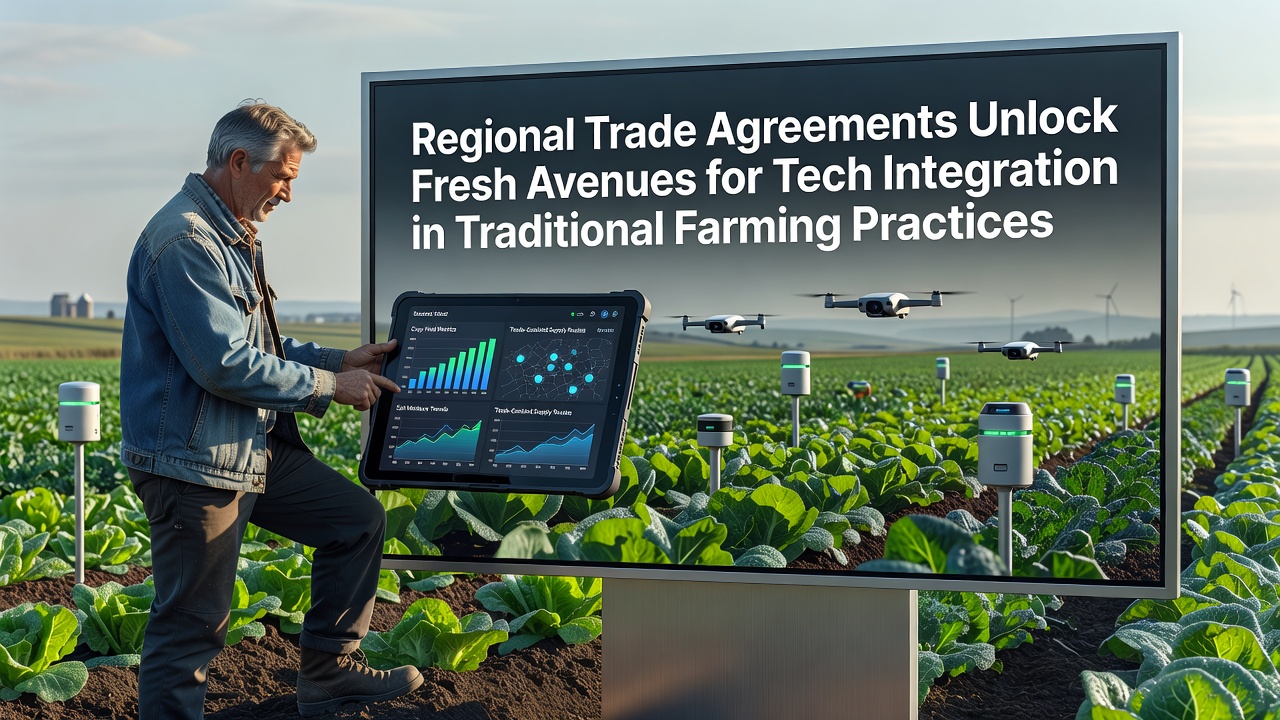
These clauses lower costs for equipment like soil moisture monitors and drone-based crop scanners, allowing smallholder operations in partner countries to integrate systems previously limited by high import duties. According to figures from the Food and Agriculture Organization of the United Nations, cross-border shipments of agricultural IoT devices rose 18 percent between 2023 and 2025 in regions covered by active trade pacts.
Provisions That Directly Support Technology Flows
Many modern agreements now embed chapters on digital trade and intellectual property that extend to farm-level applications, and these sections permit easier licensing of software platforms used for yield forecasting or livestock health tracking. Governments in participating nations report streamlined customs procedures for components such as GPS-enabled tractors and automated weather stations, which reduces delivery times from months to weeks in several documented cases.
Researchers at agricultural economics departments in Australia and Canada note that tariff reductions under the CPTPP have correlated with increased adoption rates of variable-rate fertilization systems among rice and wheat producers in member economies. Similar patterns appear in African markets following the operational launch of AfCFTA protocols, where intra-continental movement of mobile advisory applications has grown without the previous layer of duplicated testing requirements.
Observed Integration Patterns Across Regions
In October 2026, scheduled reviews of digital trade annexes in several pacts coincide with new pilot programs that connect traditional cooperatives to blockchain-based traceability networks. These networks verify origin and production methods for export crops, satisfying buyer requirements in distant markets while giving farmers real-time pricing data through integrated mobile interfaces.
One documented program in Southeast Asia links small-scale rubber and palm oil growers to platforms that record harvest volumes directly onto shared ledgers, cutting verification steps that previously required multiple paper documents. Data from the program indicates a 12 percent reduction in administrative overhead for participating farms within the first 18 months of operation.

European Union trade arrangements with Latin American partners have likewise facilitated the spread of satellite-linked pest monitoring services, and national agricultural ministries in both regions publish annual statistics showing expanded coverage among family-run coffee and cocoa operations. The services combine local weather station readings with imported analytical models, delivering alerts through existing mobile networks rather than requiring entirely new infrastructure.
Data Exchange Standards and Compatibility Gains
Agreements that harmonize data formats allow farm management software developed in one country to process information collected by hardware manufactured in another, and this compatibility reduces the need for custom reprogramming. Industry reports from organizations such as the International Food Policy Research Institute document fewer compatibility issues at border crossings for agricultural data files when common protocols are in place.
Those who track implementation find that shared standards also support joint research initiatives between universities in different member states, where datasets on soil carbon levels or water usage can be pooled without repeated format conversions. Such collaboration has produced open-source calibration tools now used by cooperatives in multiple continents.
Supply Chain Traceability Improvements
Regional pacts often include mutual recognition of certification systems, which speeds the rollout of traceability modules attached to traditional produce handling. Exporters gain teh ability to attach sensor-generated records of temperature and humidity during transit, satisfying regulatory checks at destination ports with automated submissions rather than manual inspections. Government statistical offices in Canada and the European Union record shorter clearance times for shipments accompanied by such digital documentation.
These traceability features also feed back into farm-level decision tools, where historical shipment performance data informs planting schedules and variety selection in the following season. Observers note that the loop between export records and on-farm adjustments tightens under the stable tariff environments created by the agreements.
Conclusion
Regional trade agreements continue to shape the pathways through which traditional farming operations access and apply new technologies, and ongoing reviews scheduled for late 2026 will likely refine the digital provisions further. Available statistics and program outcomes indicate that tariff relief, standard alignment, and certification recognition together lower barriers that once separated legacy practices from contemporary monitoring and management systems. Continued tracking by international bodies will reveal how these mechanisms evolve alongside next-generation tools.